
Why I Spent Two Decades In Bag Development Before Making A Single One Of My Own
After twenty years developing bags for COS, Hunter and Nanushka, Danni Dance knew exactly what was missing from the market, so she made it herself.
.webp)


For most of my career, I was certain I would never create my own product. I had spent over twenty years working in accessories product development, leading the development of bags for brands including COS, Hunter and Nanushka. My role sat at the intersection of design, materials and manufacturing, working closely with factories to take products from concept through to production. I was deeply involved in construction, costing, sampling and quality control, and spent years travelling between Italy, Turkey and Vietnam, learning how bags are actually made and why some last while others do not.
By the time the pandemic arrived, I felt increasingly conflicted about the pace of the industry. The constant demand for newness, new collections and new product often came at the expense of longevity and intention. I had a deep respect for craftsmanship, but was questioning whether the systems around it still allowed space for restraint. That tension ultimately led me to step away and launch The Hosta.
It began as a platform focused entirely on vintage and pre-owned bags. Pieces that had already stood the test of time. Bags that carried integrity, character and craft, and that still had years of life ahead of them. I wanted to create a space where people could buy thoughtfully, guided by someone who understood not just how a bag looked, but how it was made, how it aged and why it mattered.
Immersing myself so deeply in vintage changed my perspective in ways I did not expect. The more I sourced, the more patterns began to emerge, not just in what held up over time, but in what was increasingly missing from the market.
.png)
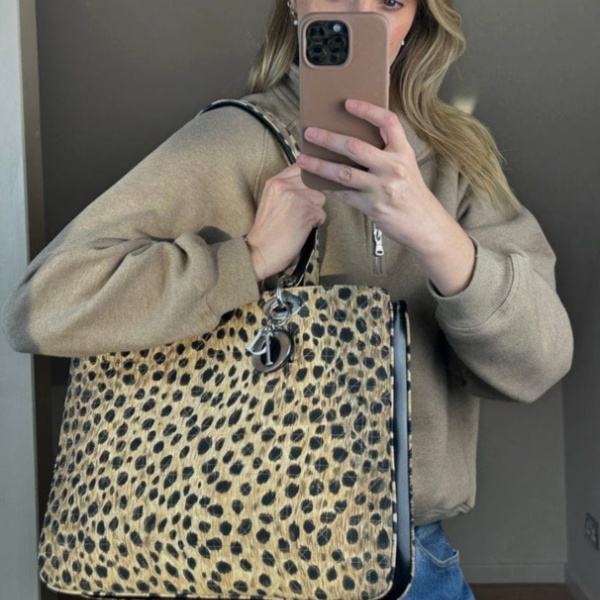
One gap became particularly clear: leopard print. Printed calf hair occupies a strange in-between space. At the very top end of the market, super-luxury brands work with exceptional Italian tanneries and highly skilled factories, using traditional methods and premium materials. Those bags are beautiful, but they are also priced between £3,000 and £5,000. At the other end of the spectrum, the high street offers plenty of leopard-printed styles, but almost all are imitation. You may get the look, but not the material, the process or the longevity. The quality is fundamentally different.
What felt absent was a considered middle ground: a bag made from genuine leopard-printed calf hair, produced in the same way and in similar environments as the highest-end pieces, but offered with restraint and fair margins rather than excess.
Vintage only reinforced that belief. Leopard-printed calf hair bags are often among the most beautiful and sought-after pieces I come across. The depth of tone, the quality of the hides and the way they age is remarkable. They are also becoming increasingly rare and expensive, which places them out of reach for many. That was a gap I felt compelled to respond to.
The decision to create the Iris Tote came from that place. From seeing a genuine gap and feeling confident it could be filled properly. If I was going to make something new, it had to exist because it genuinely filled a need. It had to sit comfortably alongside vintage rather than compete with it. And it had to be made with the same respect for craftsmanship and longevity that had drawn me to vintage in the first place.
I chose to work with a small, family-owned atelier in Scandicci, just outside Florence, where I had manufactured earlier in my career. Producing in Italy was not about the label, but about proximity, transparency and dialogue. Being able to have honest conversations, to see sampling in real time and to work closely with skilled craftspeople was essential.
.png)
The materials were approached with equal care. All leathers are sourced exclusively from a select group of certified Italian tanneries, chosen not only for the quality of their craftsmanship but for how responsibly they operate. Each hide is naturally unique, traceable and tested for durability and colour fastness. These tanneries prioritise low-impact processes, including clean water usage, water recycling, reduced chemical treatments and the use of renewable energy where possible. Every material meets strict European standards for environmental safety, worker wellbeing and transparency, a commitment that extends through the entire supply chain, including the factory itself.
What people often do not see is what it takes to make something responsibly. Producing in small batches means higher unit costs and slower timelines. It means accepting narrower margins and resisting the pressure to scale quickly. It means saying no to shortcuts, even when demand suggests you could move faster. There were multiple samples of the Iris Tote. Adjustments to proportion, handle length and internal construction. Refinements to weight and balance so the bag felt comfortable to carry every day. Every decision was questioned. Nothing was added without reason. The process was intentionally slow, not as a gesture, but because that is what good product development requires.
In many ways, creating the Iris Tote felt familiar. My role had shifted from product developer to founder, but I was drawing on everything I had learned over the previous twenty years. Understanding when to push, when to pause and when restraint was the strongest choice of all.
The Iris Tote is not an attempt to reinvent anything. It is a response to what felt missing. A bag designed to be used daily, to age quietly and to earn its place over time. Creating it did not pull me away from vintage. If anything, it deepened my respect for it.
Because once you truly understand what goes into making something well, you become even more selective about what deserves to exist at all.



.png)
.png)