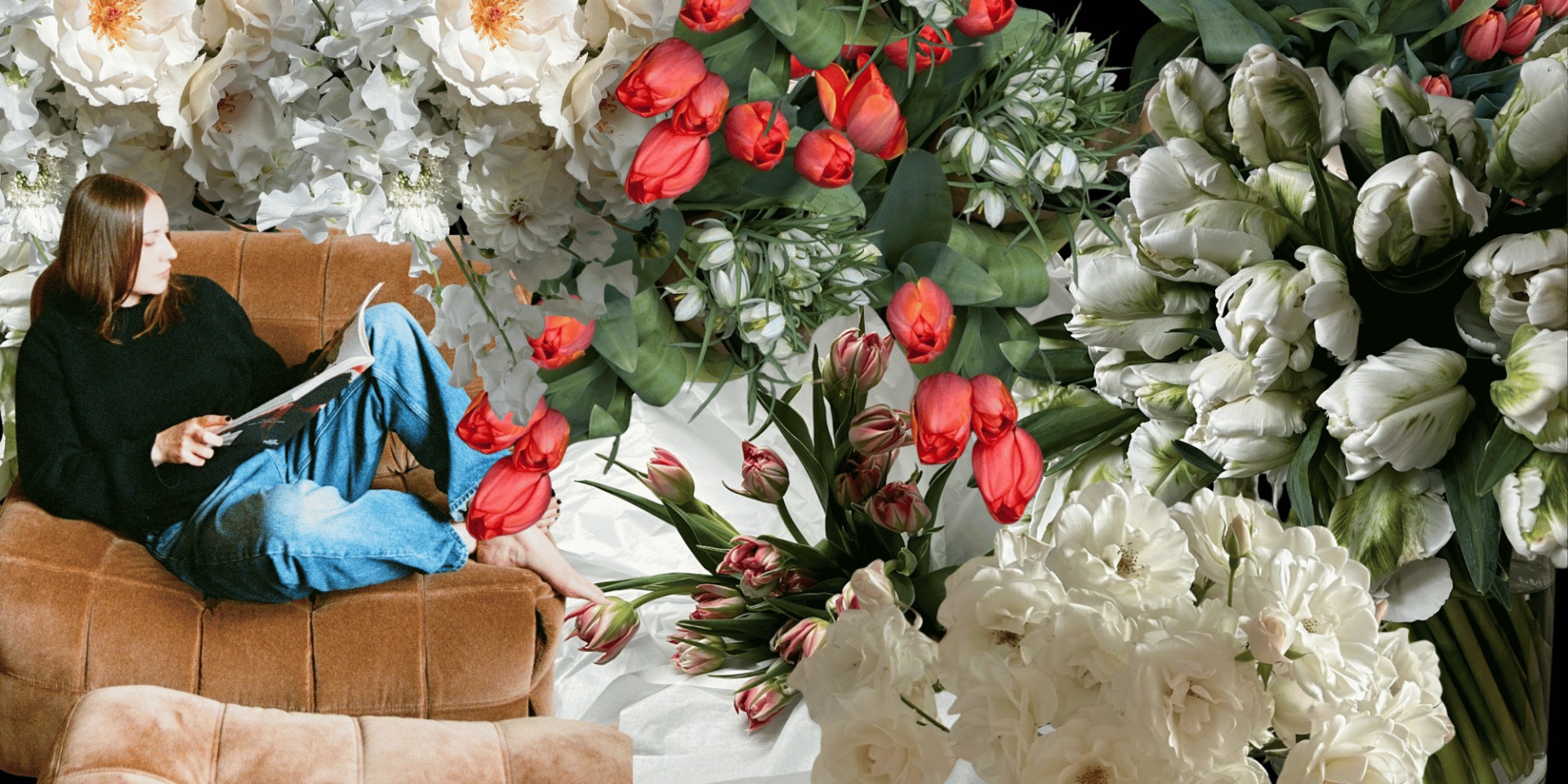
The Case For Championing British-Grown Flowers
We question where our food comes from, who made our clothes and what's in our supplements. But when did you last think about that bunch of flowers? From sweet peas and delphiniums to peonies and garden roses, florist Genna Micheli-Osborne makes the case for championing British-grown stems.
As a Grounded reader, it is fair to assume you care about the impact of your shopping choices: what you buy, who made it and how. The fashion industry has understood for some time that many of us want to be more conscious about our clothing. The same is increasingly true of food, where traceability has become central to how many of us decide what to eat, where to shop and what to share. But when was the last time you thought about that bunch of flowers you picked up on the way home?
As a florist, I am rarely asked where my flowers come from. And yet this question sits front of mind for many of us actually in the flower business, trying to navigate a complex ecosystem of growers, suppliers and wholesalers, each adding another layer to an often murky supply chain.
One of the biggest challenges in the industry right now, at least from where I stand, is confidence. Specifically, the confidence to push for better sourcing, whether that means local, seasonal or simply more considered choices. On high-profile, design-led jobs, I do not always feel sure enough to advocate for British flowers. I love talking to clients about seasonality and availability, and for the most part, people are genuinely receptive. But British stems rarely appear on the moodboard, and they struggle to compete with year-round staples like calla lilies and anthuriums that have become shorthand for a certain kind of aesthetic.
There is something worth unpacking here about the role of visual culture and instant gratification. Pushing a fresh creative concept that sits in direct opposition to what a client sees every day on Pinterest, in trend reports, in viral posts, is a risky move. This is what I think of as the anthurium trap: becoming so attached to one specific flower, one specific look, that everything else gets dismissed. Ethos quietly sacrificed in the name of a vibe.
And so I find myself asking: do I risk it, or do I just follow the moodboard? Is there even a middle ground?
Some of my peers have been championing British flowers for years, building strong businesses around a strict British-only sourcing commitment. That kind of conviction is something I deeply admire. My own hope is to reach a point where I no longer have to choose between commercial viability and sustainable sourcing, though I suspect that will take time. Traceability in the flower industry remains genuinely difficult to navigate. Last year, Buying Better, a report from Flowers From The Farm on trust and transparency in the cut flower supply chain, called for better labelling to help the entire industry make more informed choices. But my favourite line in the whole report is this: "There are no absolutes." Because being able to choose, use or prioritise British flowers is as much a privilege as it is an opportunity.
.png)
Setting aside the economics, logistics and supply chain for a moment, there is a particular kind of beauty that comes out of local farms. Perfectly imperfect stems. Wild silhouettes. Incredible scent. The kind of thing that cannot be replicated in a climate-controlled warehouse in the Netherlands.
And this matters enormously when it comes to design. Yes, there is a comfort in knowing exactly what I have ordered and precisely how it will look. But there is also a kind of grace in working from a grower's choices rather than purely my own. The constraints actually liberate something. I find myself working with shapes, textures and colours I would not have purely dictated, and arriving somewhere I might not have done otherwise. I also find British flowers easier to work with when a brief calls for dramatic form or negative space, that breathing room around a composition that gives it real presence. If you have avoided British flowers because you associate them with wicker baskets and country weddings, I would urge you to look again. The industry has moved on considerably.
Back to those absolutes. I am not suggesting we all switch overnight to an exclusively British supply. What I am advocating for is something simpler: the confidence to give British flowers more space, to have different conversations with clients and to trust your own instincts when using them.
Sourcing is relatively straightforward these days. Platforms like Stem Union act as a marketplace connecting growers and florists directly. Logistics and pricing, I can always navigate. The bigger shift is cultural. It is about feeling empowered to suggest a different approach, even when the moodboard says otherwise. It is about expanding our collective idea of what beautiful flowers look like and recognising that seasonality, traceability and creativity do not have to pull in opposite directions.
Perhaps that is what progress actually looks like. Championing British flowers is not about limiting what is possible. It is about widening it. Because if we want a floristry industry that is more resilient, more transparent and more genuinely connected to the landscapes that sustain it, then florists need to be willing to lead that change.
No items found.


.png)
.png)